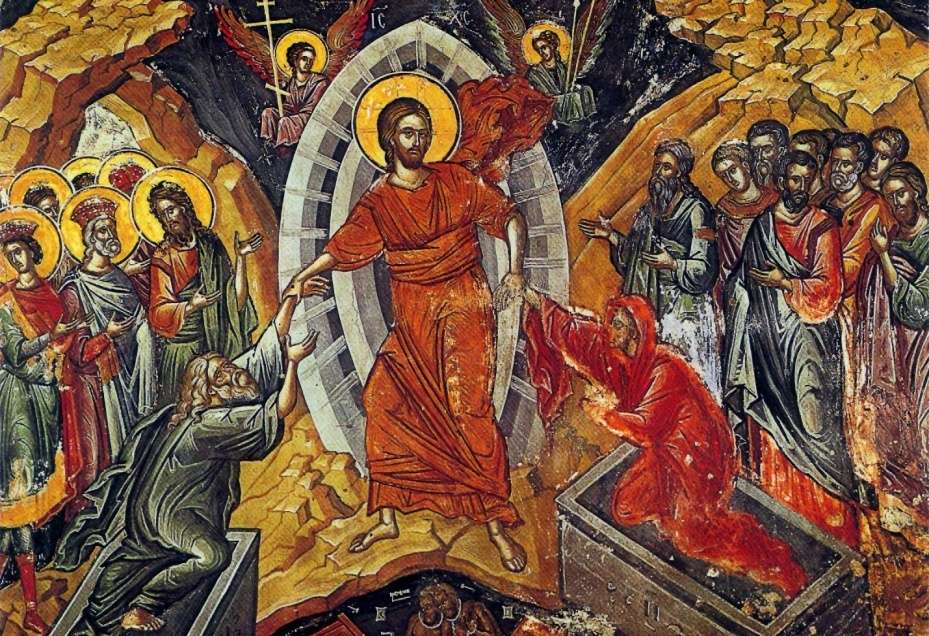
"But our citizenship is in heaven, and from it we also await a savior, the Lord Jesus Christ. He will change our lowly body to conform with his glorified body."
Philippians 3:20–21
Philippians 3:20–21
Every Sunday at Mass, we stand together and profess our faith using the Nicene Creed. Toward the end, we proclaim, “I look forward to the resurrection of the dead and the life of the world to come.” For most of us we have spoken these words countless times, but have we ever stopped to consider what they actually mean? What does it mean to look forward to the resurrection of the dead?
Most Catholics are comfortable with the idea that our souls live on after death. We imagine our loved ones in heaven, free from suffering, free from the limitations of earthly life, enjoying a peace that words cannot describe. But the Catholic Church teaches something even more profound than this. Our final destiny is not to spend eternity as disembodied spirits, but rather God intends to raise our bodies from the dead and reunite them with our immortal souls. In order to understand this, I believe we must first wrap our minds around what it means to be human.
God created us as a unity of body and soul. Our bodies are not simply containers for our souls; they are an essential part of who we are. Through our bodies, we love, serve, embrace, worship, and encounter the world around us. When God created the material world, He declared it good. But when He created humanity as a unity of body and soul, He declared it very good.
Therefore, it’s important to remember that death was never part of God’s original plan for humanity. Death is a consequence of sin, which is nothing less than a rupture of the unity between body and soul. At death, the soul separates from the body, but this separation is not meant to be permanent.
The Catechism of the Catholic Church teaches “in death the soul separates from the body, the human body decays while the soul goes to meet God, while awaiting its reunion with its glorified body” (CCC 997). You might then ask the question, what kind of bodies will we have at this reunion? The catechism gives us a clue.
Our resurrected bodies will be truly our own, yet at the same time fundamentally transformed. Those who rise to eternal life will possess glorified bodies, no longer subject to disease, aging, suffering, or death. To understand what this might look like, consider the risen Christ. At the Lord’s resurrection, His human soul was reunited to His human body. His disciples could now see Him, touch Him, and even share a meal with Him, yet His glorified body was no longer subject to the ordinary limitations of an earthly existence. His Resurrection is not only proof that life continues after death, it is the promise of what God intends to accomplish in us.
This teaching also reveals something beautiful about the dignity of the human body. If God intends to raise our bodies for eternity, then what we do with them here and now really does matter. Our bodies are instruments through which we exercise charity, practice virtue, and grow in holiness. The hands that we use in our daily work, the minds we use to study and learn, the energy we expend to care for our families and communities, are all ways we participate in God's work of love.
And perhaps the teaching of the resurrection of the body can also offer consolation during the month of November when we remember those who have died. When we stand before the grave of someone we love, we confront the painful reality of the separation caused by death. Yet Christian faith invites us to see beyond the grave because the person we loved is not destined to remain forever separated from the body through which we knew and loved them.
In the resurrection of the body, we discover the extraordinary completeness of God's plan for humanity. The God who created us body and soul will one day restore that unity in glory. What began as an act of divine love in creation will find its fulfillment in eternal life, where our whole being will give glory to the God who made us.
Through the intercession of the Blessed Virgin Mary, who was assumed body and soul into heavenly glory, may we live in joyful anticipation of the day when Christ will raise the dead, restore all things, and bring those who belong to Him into the fullness of eternal life.